Search This Blog

Friday, April 14, 2017

Paladar Dona Eutimia

Near the Plaza de la Catedral is Paladar Dona Eutimia.


It's located at the end of Callejon del Chorro. It's very popular and I would recommend making a reservation at least a week in advance. We asked our Airbnb hostess to make our reservation.


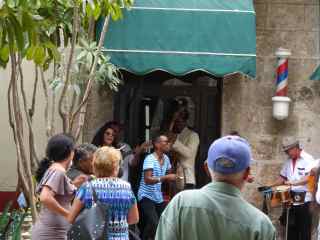
There is outdoor seating, which allows you to enjoy the musicians in the alley. Have a CUC ready to give as a tip.


We tried mojitos everywhere we went. This was 3.50 CUCs.


Croquetas de Leticia--2 CUCs. We had read that Dona Eutimia had the best croqueta in Havana. We're still not fans. It's too pasty.


Camaron al Ajillo--Shrimp with Garlic. 5 CUCs.


Ropa Vieja with rice, beans, fried plantains and vegetables--8 CUCs. This was delicious. The shredded meat was tender and flavorful.


Pollo Asado--7 CUCs. This was also very good. The chicken was moist and tender.


Sauteed vegetables--3 CUCs. This wasn't on the menu but we saw it at the next table and ordered the same. This was sautéed cabbage, peppers, onions and tomatoes.


Flan--2 CUCs. This was thick and creamy.


2017 03 07

Thursday, April 13, 2017

Plaza de la Catedral

Plaza de la Catedral is located just a few blocks northwest of Plaza de Armas. 


It features the Catedral de la Habana, built in the Cuban Baroque style. Note the asymmetry of the two towers. It's free to tour the interior but 1 CUC to climb the tower. Dress appropriately--make sure your knees are covered.


Interior of the Catedral


Statue of Pope John Paul II, who visited in 1998. He was the first pope to visit Cuba.


The organ is surprisingly modest.


On the western side of the plaza is the Casa del Marques de Aguas Claras. This was a baroque palace completed in 1760. Today, it's a restaurant.


In the portico, you can have your fortune read by practitioners of Santeria. the most popular of Afro-Cuban religion. The religion spread to Cuba from West Africa with the importation of slaves. The Santerians dress in all white with a wooden bead necklace that represents their appointed orisha or god/goddess at the heart of their worship. There are over 400 orishas.


The Museo de Arte Colonial is next door. It's housed in the Casa de los Condes de Casa Bayonas. It features 19th century furniture and ornaments. Admission is 3 CUCs, photos 2 CUCs extra.


On the eastern side of the plaza is Palacio de Lombillo, built in 1741 as the home and office of a sugar plantation owner. Today, it's the Office of the City Historian and mainly closed to the public.


You can peek inside.


The building once served as a post office and there is a stone mask ornamental mailbox built into the wall.


Outside is a statue of Antonio Gades, a Spanish Flamenco dancer.


2017 03 06

Wednesday, April 12, 2017

The Bayfront

From Oficios, turn left to reach the waterfront. You can stop in the Museo del Ron Havana Club, which traces the history and details of rum production. It's supposed to be a good tour and admission is 7 CUCs.


Further down is Sacra Catedral Ortodoxa Rusa--Cuba's only Russian Orthodox Church, opened in 2008. It's estimated that there are 5-10,000 Russians in Havana, many of whom moved here after 1959, when Cuba established diplomatic relations with the Soviet Union.

From here, you can walk along the bayside promenade although it's still in development. There's a ferry terminal where you can catch ferries to the eastern side of the bay to visit the Parque Morro-Cabana. This is mainly used by locals and cost 0.10 CUP (less than a penny). Ferries leave every 30 minutes.


Walking north along the bay front, you'll pass the cruise ship terminal.


2017 03 05

Tuesday, April 11, 2017

Plaza de San Francisco


The oldest street in Havana is Oficios, which starts at Plaza de Armas and heads south to the Plaza de San Francisco.


Plaza de San Francisco and Iglesia y Convento de San Francisco de Asis. This was a missionary school for Franciscan friars.


On the opposite side of the Plaza de San Francisco is the Lonja del Comercio. It was the Stock Exchange until the 1959 Cuba Revolution. Today, it is an office building.


In front of the Lonja is this interesting sculpture--The Conversation.


Nearby is a sculpture featuring Chopin. Not sure what Chopin had to do with Cuba.


Palacio del Marques de San Felipe y Santiago de Bejucal, a hotel on the Plaza. Costs around $300/night.


Just a little further down from the Plaza is Coche Mambi, a restored train coach from 1900 that was used by the President of  Cuba in the early decades of the 20th century. It was formerly a property of the American-owned Cuban Railroad Company. Not sure why it was here--it was out of place.


Just beyond the Coche Mambi is the Camara de Representantes, the Republican House of Representatives until it was moved to the Capitolio in 1929. It's now a museum featuring documents from the Republican era (1902-1959) and the Literacy Campaign. Cuba has a literacy rate of 99.8%, compared to the US rate of 86%. 


2017 03

Monday, April 10, 2017

Plaza de Armas

After lunch, we toured Habana Vieja (Old Havana). From O'Reilly 304, it was a 5-minute walk to Plaza de Armas, the core of Habana Vieja.


Plaza de Armas is the oldest of Habana Vieja's squares and is located on the eastern edge of Habana Vieja. It's a patch of green with benches to rest and people watch or enjoy the live music from a nearby restaurant.


Live music from nearby restaurant.


The square is lined on 3 sides with brick pavers and on one side with wood. It's the only remaining street in Habana Vieja made of wood.


The center of the square is dominated by a marble statue of Carlos Manuel de Cespedes, a Cuban planter who freed his slaves, starting the Ten Years' War declaring Cuban Independence from Spain.


On the northeastern corner of Plaza de Armas is El Templete, a scaled-down version of the Parthenon and the site of the city's first Mass in 1519. Although Cuba's largest religion is Roman Catholicism, Christmas was not celebrated as a public holiday for 30 years between 1969 and 1998. Fidel Castro needed everyone to work on the sugar harvest on Christmas.


Unfortunately, the remaining Ceiba tree that was planted when the building was inaugurated in 1828 recently fell down.


Going clockwise from El Templete is the Museo Nacional de Historia Natural (the Natural History Museum). It used to be the US Embassy in the 1930s. In front of the museum, you'll see people on their smart phones. It's one of the few places in town where there is wifi. Purchase a card with a code that gives you access to wifi for 6 CUCs/hour. It's slow download speed and not worth it.


Cell phones are not widespread. There are still pay phones--yes, they do exist.


Next up is the Museo de la Ciudad on the western edge of Plaza de Armas. This security guard, cigar in mouth, insisted on posing for a picture. Surprisingly, he wasn't looking for a tip. The Museo occupies the Palacio de los Capitanes Generales, the seat of the Spanish government from 1791 to the end of the Spanish-American War in 1898.


On the northern edge of the Plaza is the Palacio del Segundo Cabo. It was the residence of the 2nd highest ranking official in Cuba. It has been undergoing a Unesco renovation and should open as a Center for the Interpretation of Cultural Relations between Cuba and Europe.


Next to the Palacio del Segundo Cabo is the Castillo de la Real Fuerza, the oldest surviving fortress in Cuba. It's surrounded by a moat. It's 3 CUCs to enter and there is an exhibit of Cuban naval history. Unless you're a big model ship fan, it wasn't worth the cost of admission.


2017 03 05


Sunday, April 9, 2017

O'Reilly 304

We had lunch at O'Reilly 304, located as its name implies at 304 O'Reilly, between Aguiar and Habana. It's open noon-MN. We got there at 11:30 and there was no one around. We returned at 12:05 pm and there was a huge line of people.


Fried plantains are brought to the table. Eat it with a criolla sauce that's on the table.


Specials are listed on a blackboard on the wall.


There's an upstairs dining area along with a few tables downstairs.


I ordered a Daiquiri de Frutas Naturales--6 CUCs. This was guava and delicious. I saw some people ordering Jugos Naturales. The bartender was mashing fruit and adding club soda. That looked good too.


Empanadillas--5 CUCs. You could get chicken, serrano ham or tuna. I thought we would get a mixture but got only the chicken.


Cebiche Peruano--5 CUCs. This was so delicious with a nice lime tang. Very authentic as a Peruvian ceviche.


Camarones Grille--8.50 CUCs. This was disappointing. The shrimp were small, although well prepared. There were grilled peppers, onion, pineapple and fried plantains.


2017 03 05

Saturday, April 8, 2017

Shopping for Groceries in Cuba

In Cuba, you can get your groceries from state-run stores or private enterprises.


Typical state-run store with long lines waiting to get just a few staples--rice, beans, eggs, oil, soup base. We didn't see much else available.


A state-run place selling vegetables.


We peeked in the window and saw plantains, yuca, tomatoes, cucumbers, cabbage, onions and garlic. The produce were not in great shape and definitely no leafy greens in sight.


Typical private enterprise selling sausages. They're hung on display in windows. 


Another place with fresh meat.


You can get fruit from carts.


Finding bottled water can be hard. We came across this grocery store in Chinatown that sold drinks. We got a 5 liter bottle of water for 1.90 CUCs, which was a great deal. Most of the bottled water on the streets is 1 CUC for 0.5 liter bottle. It's almost cheaper to drink beer--1 CUC for a bottle of beer.


2017 03